
Assured Dental Care is a dental clinic in Andheri West, Mumbai, where a single tooth implant is planned one gap at a time. The post that goes into the jawbone, the connector and the crown are all chosen for the width of your gap, the bone beneath it and the teeth that sit either side. It is a titanium post that takes the place of a lost root, with one custom crown fixed to it, and it is often considered when the teeth beside the gap are sound.
Your care is led by Dr. Shreya Shah, Chief Dentist. Before any implant is discussed she checks whether the tooth in question can still be treated and kept. If you are searching for an implant dentist in Andheri West because of one lost tooth, the first visit gives you an examination, X-rays and a plain explanation of the steps, the waiting time and the risks.
Medically reviewed by Dr. Shreya Shah, Chief Dentist. Last reviewed 9 October 2026. Registered with the Maharashtra State Dental Council (registration A 30472, 2015). Dr. Shah is also the treating dentist at this clinic.
Replacing one missing tooth with an implant at Assured Dental Care in Andheri West, Mumbai means a titanium post in the jawbone and a custom crown fixed to it. Dr. Shreya Shah plans the case after an examination and X-rays. A healing period of three months or more is common before the crown is fitted.
Examination, X-rays and planning start at your first visit, subject to availability.
The implant stands on its own in the bone, so the healthy teeth beside the gap are not shaped.
The position of the implant follows the crown it will carry, not the bone alone.
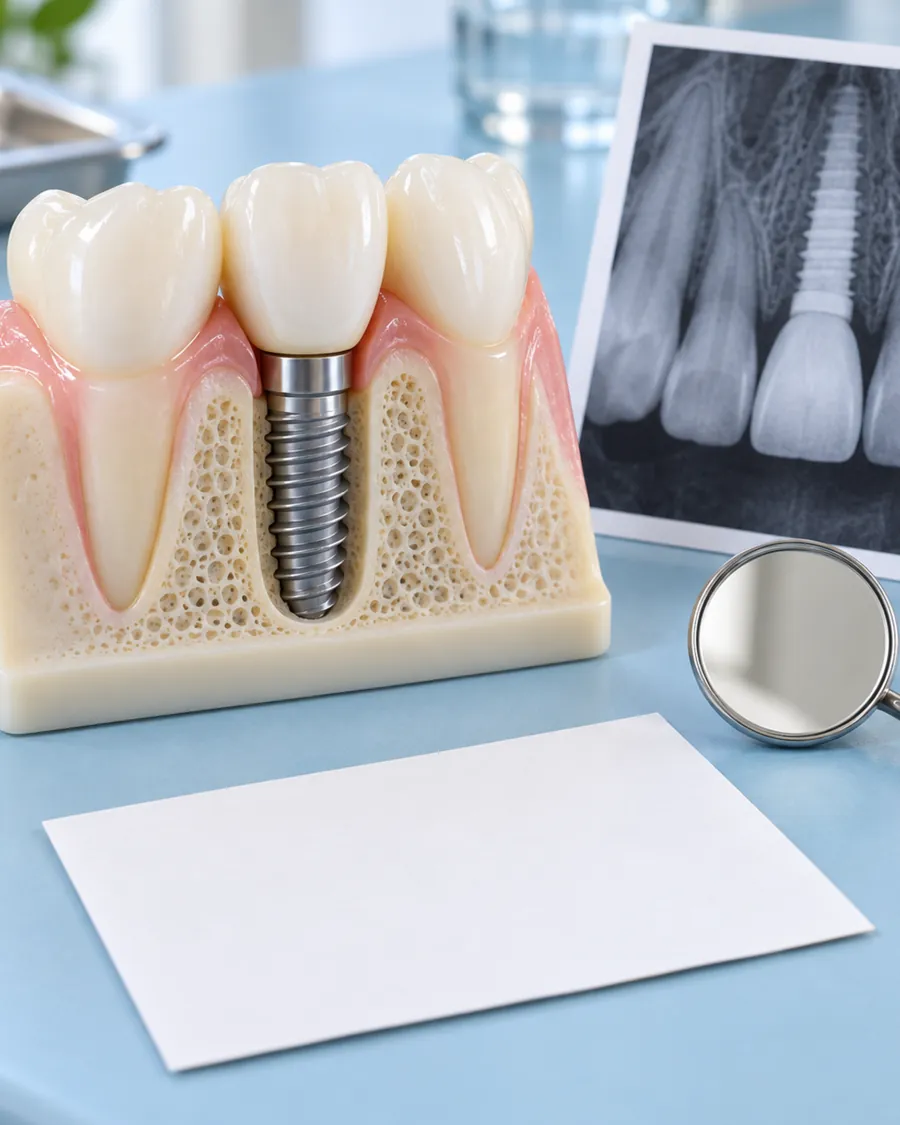
A single tooth implant has three parts. The implant is a screw-shaped post, usually made of titanium, placed in the jawbone. The abutment is a small connector that joins the post to the crown. The dental crown is the visible tooth, made to match the teeth beside it. Over the healing period the bone grows against the post, a process called osseointegration.
When one tooth is missing, the two main alternatives are a dental bridge and leaving the gap. A bridge is anchored to the teeth on either side, so those teeth have to be shaped. A tooth implant stands on its own in the bone, so the neighbouring teeth are left untouched.3
One tooth is usually lost to deep decay, a fracture, an infection at the root, gum disease or an injury. Once a tooth is gone, the bone under the gap slowly shrinks, and the teeth beside the gap can lean into the space. Replacing the tooth in good time keeps the bite more even and can make treatment simpler.
One implant replaces one tooth from the root up, and it does not rely on the teeth beside it.

Dr. Shreya Shah decides suitability only after an examination, a medical history and X-rays. These are the general patterns.
Not every lost tooth must be replaced with an implant. A bridge, a denture or leaving the gap may be the better fit for some people. If the tooth is still in the mouth but failing, Dr. Shah first checks whether root canal treatment can keep it, and whether periodontal treatment is needed before any surgery. If several teeth are missing, see multiple teeth implants instead.
Suitability depends on your gums, bone, health and habits, and it is confirmed only after an examination.
The right fit depends on the gap, the neighbouring teeth and how much treatment you want. Dr. Shah explains each option, including not replacing the tooth.
A titanium post in the bone with a crown on it. The neighbouring teeth stay untouched, and the treatment needs surgery and a healing period. Read the main dental implants page for the full process.
Healing: about 3 months or moreA bridge uses the teeth on both sides of the gap as anchors. It is quicker and needs no surgery, but healthy teeth must be shaped. The related bridge page below explains it in full.
Often a few weeksA small removable denture can fill the gap without surgery. Some patients choose to leave a gap at the back of the mouth after talking through the effects. See dentures.
Often a few weeks| Compare | Single tooth implant | Fixed bridge | Removable denture |
|---|---|---|---|
| Surgery needed | Yes, under local anaesthesia | No | No |
| Neighbouring teeth shaped | No | Yes | Sometimes, for clasps |
| Fixed in the mouth | Yes | Yes | No |
| Typical timeline | About 3 to 9 months | A few weeks | A few weeks |
| Supports the jawbone | Yes, the post sits in the bone | No | No |
Each option has a place, and we explain all of them before you choose.
Most patients have a planning visit, a surgery visit, a healing period and a fitting visit. Your own plan may have more or fewer steps.
The crown is planned first and the implant is placed to suit it.
Dr. Shah reviews the missing tooth, your dental history, medical conditions, medicines, allergies and tobacco use. She examines the gap, the neighbouring teeth, the gums and your bite.
Digital X-rays show the neighbouring teeth and the bone. If they do not show enough, a 3D scan such as a CBCT may be advised to check the bone, nerves and sinus, and you are told why it is needed.
The implant position is planned from the crown it must carry. The width and height of the gap, the bite and the colour of the neighbouring teeth all shape the plan. You hear the alternatives, the stages and the risks before you consent.
If the tooth is still present and cannot be saved, it is taken out by tooth extraction. If the bone is too thin, a bone graft builds it up, either first or during placement.4
The area is numbed and you stay awake. A channel is prepared in the bone, the implant is placed and the gum is closed with stitches or fitted with a healing cap.
The gum heals over days to weeks while the bone bonds to the implant. Many implants need at least three months before they carry the crown. A temporary tooth can sometimes be used meanwhile if the site allows.
If the implant was covered by gum, a small procedure uncovers it and a healing abutment shapes the gum. An impression or digital scan then records the position for the laboratory.
The implant crown is checked for fit, shape, colour, contact with the neighbouring teeth, cleaning access and bite before it is attached. It may be screwed in or cemented, depending on the design.
Cost depends on your evaluation. A single implant can look simple, yet every gap needs its own plan, so no one figure fits all.
After the examination and X-rays, Dr. Shreya Shah goes through each stage with you, and the cost of every stage is explained before you choose whether to go ahead.
Call 08806796696 or message us on WhatsApp. Go to a hospital emergency department if you struggle to breathe or swallow, or if swelling spreads to your eye or neck. For a crown that has come loose, or another urgent problem, see dental emergency treatment.
Most problems are simpler to fix when we hear about them early.
A fair plan lists the reasons to wait or to choose something else along with the reasons to go ahead.
The first visit is for answers, not surgery. Come with your questions about the gap, your health and the time you can give.
Carry any earlier X-rays or reports and a list of your regular medicines. Mention allergies, diabetes, heart problems, blood thinners and tobacco. If a crown has come loose or you have pain or swelling, call us first and we will try to see you the same day.
Call 08806796696 to book.

Tooth-saving check firstCrown planned firstReferral when needed
Dr. Shah describes each option, its steps and its risks in everyday words, and you decide in your own time. If dental treatment makes you anxious, tell us at the start so that we can go at a pace that suits you.
A damaged tooth is assessed for repair before removal is advised. An implant enters the conversation when the tooth cannot reasonably be kept, or is already gone.
Width of the gap, bite and the colour of the teeth beside it shape where the post goes, instead of the bone deciding alone.
Digital X-rays come first, and a CBCT scan is advised only when the X-rays leave questions about bone, nerves or sinus.
When a case needs training beyond what is available here, Dr. Shah says so and arranges care with a suitably trained clinician.
These are patient reviews of the clinic and Dr. Shah, copied word for word from the clinic’s Google Business Profile. They describe the experience of visiting the clinic and are not evidence of how any treatment will turn out for you.
“Lovely experience. Made my dental appointment so comfortable I forgot it was my first time .”
“I have been going to Dr Shreya since the past 7years for my dental treatment and that speaks volumes.I don’t mind travelling a little extra just to get treated by her.She is the most genuine dentist around.”
“Hi....it was a very good experience Doctor and staff is very professional and very attentive Thankful for easy process and excellent care”
Assured Dental Care is a dental clinic in Andheri West, Mumbai, next to Lallubhai Park in Parsi Colony. A single tooth implant evaluation with Dr. Shreya Shah can be booked by phone or WhatsApp. The map shows the exact location of the clinic. If your problem is urgent, please call before you travel so that we can arrange the earliest visit available. Please bring any earlier reports.
Straight answers to what patients ask before they book. If your question is not here, call or message us.
A single tooth implant is planned for each person, so the cost is given only after your evaluation. It depends on the implant system, whether the tooth must be removed first, how much bone is present, whether a bone graft is needed, the material of the crown and the imaging required. After the examination, Dr. Shreya Shah explains the plan and the cost of each stage before you decide.
Neither is better for everyone. An implant does not need the neighbouring teeth to be shaped, and it needs surgery and a longer timeline. A bridge is quicker and avoids surgery, but it relies on the teeth beside the gap. Dr. Shah compares both for your mouth at the evaluation.
Implant placement is normally done under local anaesthesia, so the area is numb and you stay awake. You may feel pressure or vibration. Mild soreness, swelling or bruising can follow and usually settles over several days. Tell us if pain gets worse instead of better after the third day.
A straightforward implant commonly takes about three to nine months from the first visit to the final crown. In many cases the implant needs at least three months to bond with the jawbone. Removing a tooth, a bone graft or a slow-healing site can make the timeline longer.
A same-day temporary tooth is possible in selected cases. It depends on whether there is infection, the quality of the bone, how firmly the implant sits and the position of the tooth. We do not promise it before the findings are reviewed.
After a tooth is lost, the bone under the gap slowly shrinks and neighbouring teeth can drift into the space. A long wait can mean a bone graft is needed before an implant. It does not mean an implant is no longer possible, but it can add steps.
Implants can work for many years, but no implant or crown can be promised for life. Studies report that most implants are still in place ten years after placement, and some do fail. Cleaning habits, gum health, smoking and regular check-ups all affect how long it lasts. The crown can wear or loosen even when the implant itself is stable.
Brush the crown and the gum line twice a day and use the interdental brush or floss we recommend. Attend maintenance visits so the gum, bone and bite can be checked. An implant cannot get a cavity, but plaque can inflame the gum and bone around it.
If one tooth is missing, a tooth is failing or a gap bothers you, an evaluation shows whether a single tooth implant suits you. If another clinic has given you an implant plan, we are glad to give a second opinion. Call or message us in clinic hours and we will confirm a time.
Monday to Saturday, 10:00 AM to 7:30 PM.
Read the full guide to implants if you want the overview of every implant option.
A fixed bridge is the usual alternative when you want a replacement without surgery.
Read this if two or more neighbouring teeth are missing.
See all dental treatments at Assured Dental Care, or read about our general dentist in Andheri West.
Written and reviewed by: Dr. Shreya Shah, Chief Dentist, Maharashtra State Dental Council registration A 30472. Last reviewed 9 October 2026. Dr. Shah is also the clinic’s treating dentist, and this page describes treatment that Assured Dental Care provides.
On the review date, Dr. Shah read the whole page and checked each clinical statement, timeline and warning sign against the sources listed below. The page is next reviewed within six months, and sooner if a source or the clinic’s process changes. To report an error, call or message the clinic using the details above.
This page is general information for patients. It is not a diagnosis or a substitute for an examination by a dentist. Treatment, timelines and outcomes vary from person to person.
