
Assured Dental Care is a dental clinic in Andheri West, Mumbai, where dental bridges are planned around the gap you have, the strength of the teeth beside it and the way you bite. A dental bridge is a fixed false tooth, or a short row of false teeth, that is joined to crowns on the teeth at each end of the gap, so that it stays in your mouth and is not taken out for cleaning like a denture. It restores chewing and appearance without surgery.
Your care is led by Dr. Shreya Shah, Chief Dentist, who first checks whether the missing tooth is better replaced with a bridge, an implant or a denture. If you are looking for a dentist in Andheri West to replace a missing tooth, the first step is an examination and an X-ray, followed by a clear explanation of the options, the visits and the risks.

Medically reviewed by Dr. Shreya Shah, Chief Dentist. Last reviewed 9 October 2026. Registered with the Maharashtra State Dental Council (registration A 30472, 2015). Dr. Shah is also the treating dentist at this clinic.
A dental bridge at Assured Dental Care in Andheri West, Mumbai replaces a missing tooth with a false tooth joined to crowns on the teeth at each end of the gap. Dr. Shreya Shah plans each bridge after an examination and X-ray. A bridge usually takes two visits about one to two weeks apart.
Examination and an X-ray start at your first visit, subject to availability.
A bridge stays in place when you eat and speak, and you do not remove it.
A conventional bridge is made with local anaesthesia in the chair, without surgery in the jawbone.
A dental bridge has two parts. The false tooth that fills the gap is called a pontic. The teeth at each end of the gap, called abutments, are shaped and covered with crowns, and the pontic is joined to those crowns so that the three pieces act as one fixed unit.1
A conventional bridge needs the abutment teeth to be shaped, which cannot be undone. A resin-bonded bridge uses a small metal or ceramic wing bonded to the back of a neighbouring tooth and needs far less shaping, but it suits only some gaps. An implant-supported bridge is held by implants instead of natural teeth, and it is covered on our multiple teeth implants page.2
Teeth are usually lost to decay, gum disease, fractures or injury. After a tooth is gone, the teeth beside the gap can lean into it and the tooth opposite can grow out of position, which makes later treatment harder. A bridge, a single tooth implant or a denture can fill the space, and we compare them for you.
A bridge joins a false tooth to crowns on the teeth either side of the gap, so it stays fixed in the mouth.
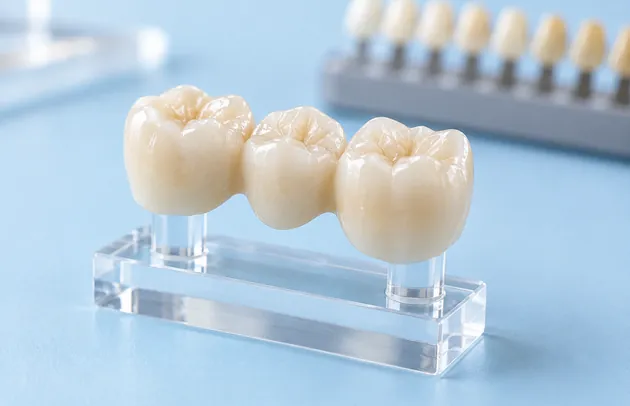
Dr. Shreya Shah decides this only after an examination and an X-ray. These are the general patterns.
If the anchor teeth need protection first, root canal treatment or a dental crown may come before the bridge. If gum disease is present, gum treatment usually comes first. If several teeth are missing, a partial denture or implants may be more suitable.
A bridge depends on the strength of the teeth beside the gap, and an examination shows whether they can carry it.
The right choice depends on the gap, the teeth beside it and how much treatment you want. Dr. Shah explains each option, including not replacing the tooth.
Crowns on the teeth at both ends of the gap carry the false tooth. It is strong and widely used, but the anchor teeth must be shaped.
Usually 2 visitsA metal or ceramic wing is bonded to the back of a neighbouring tooth. It needs little or no shaping, but it suits only some gaps and can come loose.
Often 2 visitsAn implant replaces the root as well as the tooth, and a removable denture needs no surgery. See dental implants for the implant route.
Planned per mouth| Compare | Conventional bridge | Resin-bonded bridge | Dental implant |
|---|---|---|---|
| Surgery needed | No | No | Yes, under local anaesthesia |
| Neighbouring teeth shaped | Yes, both sides | Little or none | No |
| Typical timeline | A few weeks | A few weeks | About 3 to 9 months |
| Fixed in the mouth | Yes | Yes | Yes |
| Main risk | Abutment tooth problems | Wing comes loose | Implant problems |
Each option has a place, and we explain all of them before you choose.
A bridge usually takes two visits, about one to two weeks apart while the laboratory makes the bridge. Your plan may have more or fewer steps.1
A well-fitting bridge depends on careful shaping, an accurate impression and a bite check.
Dr. Shah examines the gap, the teeth either side, the gums and your bite, and takes an X-ray to see the roots and the bone.
Decay is removed, gum problems are treated and a weak tooth may need root canal treatment or building up before it can carry a bridge.
You and Dr. Shah choose the type of bridge and its material, and the colour is matched to your teeth.
The anchor teeth are numbed with local anaesthetic and shaped all round so that crowns can fit over them.
An impression or digital scan records the shaped teeth, the gap and your bite. The record goes to the laboratory with the shade and instructions.
A temporary bridge covers the shaped teeth and fills the gap while the final bridge is made. It is held with weak cement, so avoid sticky food.
At the second visit the temporary bridge is removed. The final bridge is checked for fit, appearance, bite and cleaning access, adjusted if needed and cemented in place.
You are shown how to clean under the false tooth. A review visit checks the bite and the gums, and later check-ups look at the edges of the crowns.
Cost depends on your evaluation. A dental bridge is planned for each mouth, so no single figure fits everyone.
Two bridges can need very different work. After the examination and X-ray, Dr. Shreya Shah explains the stages, and the cost of each stage is discussed before you decide to go ahead.
Call 08806796696 or message us on WhatsApp. If you have trouble breathing or swallowing, or swelling is spreading to your eye or neck, go to a hospital emergency department. For a loose bridge or other urgent problem, see dental emergency treatment.
A loose or sore bridge is easier to fix when we see it early.
A bridge shapes healthy teeth in most cases, so we advise one only when the benefit is clear.
Your first visit is an examination and a plan. If the teeth are ready, shaping and the impression can sometimes be done at the same visit, subject to availability.
Bring any earlier X-rays or reports, and a list of the medicines you take. Tell us about allergies, diabetes, heart conditions and blood thinners, and about any grinding or clenching. If a bridge has come loose or you have swelling or pain, call us first so that we can arrange the earliest visit.
Call 08806796696 to book.

Tooth-saving check firstOptions comparedReferral when needed
Dr. Shah explains each step in plain language and checks that you are comfortable throughout, and you decide at your own pace. If you are anxious about dental treatment, tell us at the start and we will go at a pace that suits you.
Dr. Shah checks whether a damaged tooth can be treated and kept before an extraction is recommended, and whether the teeth beside a gap are strong enough to carry a bridge.
A bridge, an implant and a denture are explained side by side, with what each one means for the neighbouring teeth, so that you choose with the facts.
The gap, the anchor teeth, the gums, the bite and the X-ray are reviewed before a bridge is advised.
If a case needs training beyond what is available, Dr. Shah says so and arranges coordinated care with a suitably trained clinician.
These are patient reviews of the clinic and Dr. Shah, copied word for word from the clinic’s Google Business Profile. They describe the experience of visiting the clinic and are not evidence of how any treatment will turn out for you.
“Most relaxing dental clinic I have ever been to,and I have been to a few.what I liked the most of Dr Shreya gave me 3treament options and I was explained pros and cons of everything.”
“I am staying 45 minutes away from Dr.Shreya’s clinic but thn also I preferred to go at her only …she is very good doctor”
“Dr. Shreya is really friendly and welcoming, she keeps helps you stay comfortable throughout the procedures”
“Outstanding service from start to finish. The staff is warm and courteous, and Dr Shreya is honest, skilled, and efficient.”
Assured Dental Care is a dental clinic in Andheri West, Mumbai, next to Lallubhai Park in Parsi Colony. You can book a dental bridge evaluation with Dr. Shreya Shah by phone or WhatsApp. The map shows the exact location of the clinic. If your problem is urgent, please call before you travel so that we can arrange the earliest visit available. Please bring any earlier reports.
Straight answers to what patients ask before they book. If your question is not here, call or message us.
A dental bridge is planned for each mouth, so the cost is given only after your evaluation. It depends on the type of bridge, the number of teeth it replaces, the material, whether the anchor teeth need root canal treatment or gum treatment first, the laboratory work and the imaging required. After the examination, Dr. Shreya Shah explains the plan and the cost of each stage before you decide.
A bridge is made in a laboratory from ceramic, metal or a metal base covered with a tooth-coloured layer. The replacement tooth is joined to crowns on the teeth at each end of the gap. Dr. Shah explains the materials and their trade-offs for your teeth.
For a conventional bridge, yes. The anchor teeth are shaped so that crowns can fit over them, and this cannot be undone. A resin-bonded bridge needs much less shaping, but it suits only some gaps. An implant avoids shaping the neighbouring teeth altogether. We compare these for your mouth.
A bridge usually takes two visits. At the first the anchor teeth are shaped, an impression or scan is taken and a temporary bridge is fitted. The laboratory makes the final bridge, which is fitted at the second visit, commonly one to two weeks later. Extra treatment adds visits.
Brush twice a day with fluoride toothpaste and clean under the false tooth every day with floss threaders, interdental brushes or a water flosser, as we show you. Plaque trapped under a bridge can cause decay and gum disease in the anchor teeth.
A bridge will need repair or replacement at some point. How long it lasts depends on the strength of the anchor teeth, how well you clean, your bite and your gum health. We cannot promise a number of years.
Neither is better for everyone. A bridge is quicker and needs no surgery, but it relies on the teeth beside the gap. An implant needs surgery and a longer timeline, and it leaves the neighbouring teeth alone. Dr. Shah compares both for your mouth at the evaluation.
Keep the bridge somewhere clean and do not try to glue it. Call us the same day so that we can see you, and tell us if the anchor teeth are sore or swollen. We explain how to protect the teeth until you are seen.
If you have a missing tooth, a gap that is getting wider or a bridge that has come loose, an evaluation shows what the teeth need. If you already have a bridge plan from another clinic, we are happy to give a second opinion. Call or message us during clinic hours and we will confirm a time with you.
Monday to Saturday, 10:00 AM to 7:30 PM.
Read this if you want a replacement that leaves the neighbouring teeth untouched.
A removable denture suits larger gaps and needs no surgery or shaping of teeth.
A bridge is held by crowns, so this page explains how a crown is made.
See all dental treatments at Assured Dental Care, or read about our general dentist in Andheri West.
Written and reviewed by: Dr. Shreya Shah, Chief Dentist, Maharashtra State Dental Council registration A 30472. Last reviewed 9 October 2026. Dr. Shah is also the clinic’s treating dentist, and this page describes treatment that Assured Dental Care provides.
On the review date, Dr. Shah read the whole page and checked each clinical statement, timeline and warning sign against the sources listed below. The page is next reviewed within six months, and sooner if a source or the clinic’s process changes. To report an error, call or message the clinic using the details above.
This page is general information for patients. It is not a diagnosis or a substitute for an examination by a dentist. Treatment, timelines and outcomes vary from person to person.
