
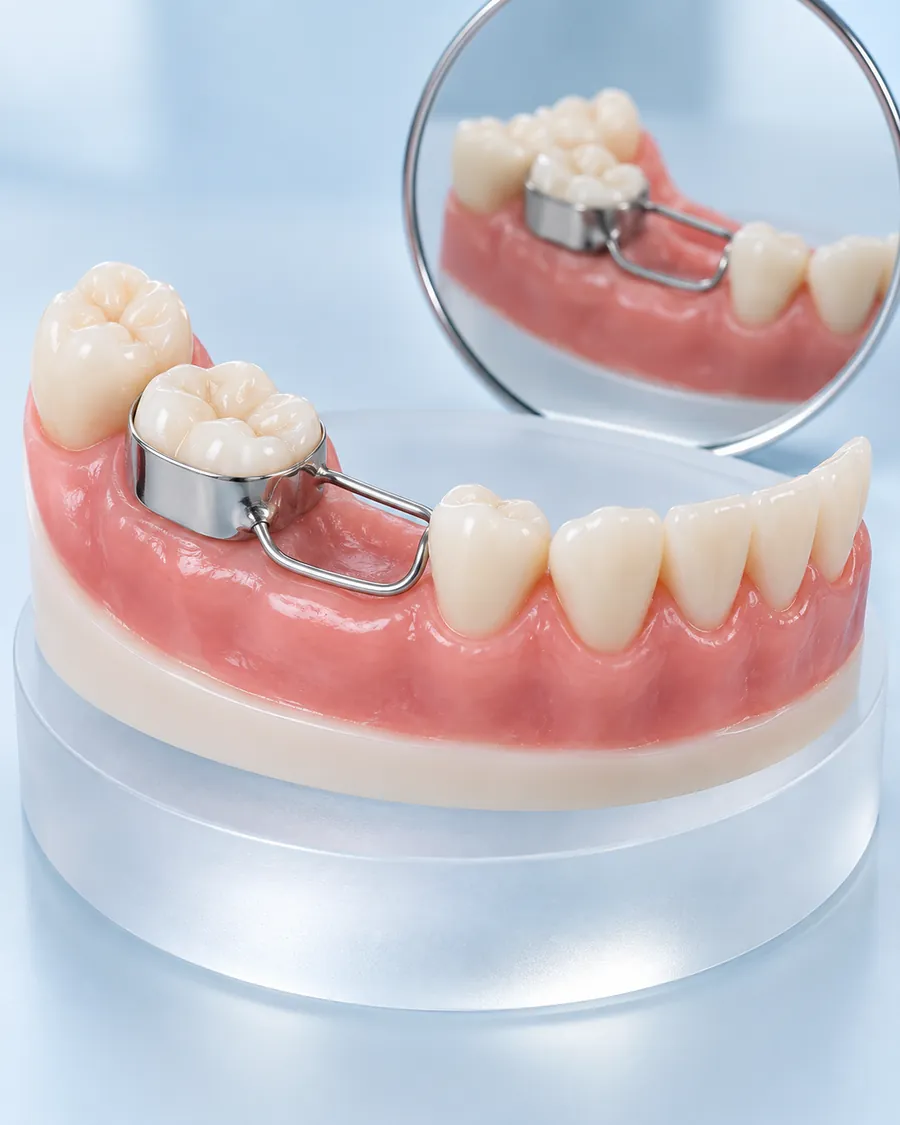
Assured Dental Care is a dental clinic in Andheri West, Mumbai, where a space maintainer is considered when a child loses a baby tooth earlier than expected. A space maintainer is a small appliance, usually metal, that is fixed to a neighbouring tooth to hold open the gap left by the lost tooth. This keeps room for the adult tooth that is waiting underneath, so that the teeth beside the gap do not drift into the space and cause crowding later.
Your child's care is led by Dr. Shreya Shah, Chief Dentist, who first checks which tooth has been lost, how old your child is and how close the adult tooth is to coming through. If you are looking for a dentist in Andheri West for your child's early tooth loss, the first step is an examination and an X-ray, followed by a clear explanation of whether a space maintainer is needed and which type suits.
Medically reviewed by Dr. Shreya Shah, Chief Dentist. Last reviewed 9 October 2026. Registered with the Maharashtra State Dental Council (registration A 30472, 2015). Dr. Shah is also the treating dentist at this clinic.
A space maintainer at Assured Dental Care in Andheri West, Mumbai is a small appliance that holds the space left by a baby tooth lost too early, so that the adult tooth has room to come through. Dr. Shreya Shah examines your child and takes an X-ray first, because not every lost tooth needs one.
An examination and X-ray can often be arranged quickly, subject to availability.
A space maintainer keeps the gap open so the adult tooth can come through in line.
Not every lost baby tooth needs one, and we say so when it does not.
A space maintainer is an appliance that holds the space where a baby tooth used to be. Baby teeth act as guides for the adult teeth. When a baby tooth, especially a baby molar, is lost early because of decay, infection or injury, the teeth beside it can tilt or drift into the gap. The adult tooth that follows may then have no room and may come through crooked or stay buried.1
Whether a child needs one depends on which tooth was lost, the child's age, the position of the adult tooth on the X-ray and how soon it is due. If the adult tooth is about to come through, nothing may be needed. Fixed and removable types have been compared in a systematic review of studies in children.2
Early loss of a baby tooth is often the result of decay, covered under children's dentistry, or of extraction of a tooth that could not be saved. Preventing the next cavity, with fluoride and good cleaning, protects the remaining baby teeth.
A space maintainer keeps a gap open after early tooth loss, so that the adult tooth can come through in line.

Dr. Shreya Shah decides this only after an examination and an X-ray. These are the general patterns.
If decay was the cause of the loss, a filling in other teeth may be needed to protect them. If a baby tooth has to come out, see tooth extraction. If your child has pain or swelling, see dental emergency treatment.
A space maintainer is used when early loss puts the adult tooth's room at risk, and the X-ray shows whether it does.
The right choice depends on which tooth was lost and how many. Dr. Shah explains the options, including doing nothing.
A metal band is cemented to the tooth next to the gap, and a wire loop holds the space. It is the usual choice for a single lost baby molar.
FixedA wire runs across the inside of the lower teeth and is attached to the back molars. It is used when teeth have been lost on both sides of the lower jaw.
FixedIf the adult tooth is about to come through, or a front tooth was lost, we may just watch with regular X-rays. Orthodontic planning may follow if space is already lost.
After discussion| Compare | Band-and-loop | Lingual arch | Watching |
|---|---|---|---|
| Used for | One lost baby molar | Lost teeth on both sides, lower jaw | Adult tooth close to coming through |
| Fixed or removable | Fixed | Fixed | Not applicable |
| Fitting visits | Two short visits | Two short visits | Regular checks |
| Cleaning | Around the band and loop | Around the bands and wire | Normal |
| Main risk | Loosening, plaque, breakage | Loosening, plaque, breakage | Space may close |
The type follows the tooth that was lost, and sometimes the right step is to wait and watch.
A fixed space maintainer usually takes two short visits. Your child's plan may differ.1
A space maintainer works only while it stays in place, so regular checks are part of the treatment.
Dr. Shah examines the teeth and gap and takes an X-ray, which shows the adult tooth under the gum and how far it is from coming through.
You are told whether a space maintainer is needed, the type, how long it will be in and what care it needs. Your child is told in simple words.
A metal band is fitted around the neighbouring tooth. A small piece of rubber or a spacer may be placed beforehand to make room for the band.
An impression of the band and the gap is taken, which a laboratory uses to make the appliance.
The laboratory makes the loop or arch to fit the band. This takes some days, and the child returns for the second visit.
The appliance is tried in, checked for fit and comfort and then cemented. The bite is checked.
You and your child are shown how to clean around it and what food to avoid, such as sticky sweets.
Regular visits check the appliance and the adult tooth with X-rays. It is removed when the adult tooth is ready to come through.
Cost depends on your child's evaluation. A space maintainer is planned for each child, so no single figure fits everyone.
Two children who lose a baby tooth can need very different plans. After the examination and X-ray, Dr. Shreya Shah explains the plan to you, and the cost of each stage is discussed before you decide to go ahead.
Call 08806796696 or message us on WhatsApp. If your child has trouble breathing or swallowing, or swelling is spreading to the eye or neck, go to a hospital emergency department. For a swallowed appliance or other urgent problem, call us first, and see dental emergency treatment.
A space maintainer helps only while it is in place and clean, so please call us if it comes loose.
A space maintainer is a simple appliance with a clear job, and we advise one only when it will help.
The first visit is an examination and a plan. We do not fit an appliance until we have an X-ray and have talked it through with you.
Bring any earlier X-rays and tell us which tooth was lost and when. Tell your child that it is a visit to look at teeth and make something to keep a space. If your child has pain or swelling, call us first.
Call 08806796696 to book.

X-ray before any applianceOnly when it helpsReferral when needed
Dr. Shah explains what she finds to you and to your child in simple words, and you decide together. If your child is nervous, tell us when you book so that we can go slowly and stop when your child needs a break. We would rather you ask every question than leave with doubts, so please bring a list.
The adult tooth is checked on an X-ray, so a space maintainer is fitted only when it will help.
If the adult tooth is about to come through, we say so, and we do not fit an appliance that is not needed.
You are shown how to clean around the appliance and why regular checks matter.
If space has already closed or the case is complex, Dr. Shah says so and arranges coordinated care with a suitably trained orthodontist or paediatric dentist.
These are patient reviews of the clinic and Dr. Shah, copied word for word from the clinic’s Google Business Profile. They describe the experience of visiting the clinic and are not evidence of how any treatment will turn out for you.
“Me and my family have been visiting Dr Shreya for a few years now. She makes us feel very comfortable and at ease. She is always accommodating us on urgent basis when required. Would recommend her.”
“Lovely experience. Made my dental appointment so comfortable I forgot it was my first time .”
“Dr. Shreya is really friendly and welcoming, she keeps helps you stay comfortable throughout the procedures”
Assured Dental Care is a dental clinic in Andheri West, Mumbai, next to Lallubhai Park in Parsi Colony. You can book a visit about a space maintainer with Dr. Shreya Shah by phone or WhatsApp. The map shows the exact location of the clinic. If your problem is urgent, please call before you travel so that we can arrange the earliest visit available. Please bring any earlier reports.
Straight answers to what patients ask before they book. If your question is not here, call or message us.
A space maintainer is planned for each child, so the cost is given only after the evaluation. It depends on the type of appliance, which tooth was lost, whether it is made in a laboratory, the number of visits, the X-rays and any repairs or replacement as the child grows. After the examination, Dr. Shreya Shah explains the plan and the cost of each stage to the parent or carer before any treatment is done.
A space maintainer is a small appliance, usually made of metal, that holds open the space left by a baby tooth that has been lost early, so that the adult tooth below has room to come through. Without it, neighbouring teeth can drift into the gap.
No. It depends on which tooth was lost, how old your child is and how close the adult tooth is to coming through. A tooth lost near the time it would have fallen out anyway usually needs nothing, and front teeth often do not. Dr. Shah decides after an examination and, where needed, an X-ray.
A band-and-loop is fixed to one tooth with a wire loop that holds the space on one side. A lingual arch is a wire across the inside of the lower teeth, used when teeth have been lost on both sides. Removable ones, like small plates, exist but need the child to wear them. Dr. Shah explains which suits your child.
Fitting does not hurt, and no injection is usually needed. It can feel strange for a few days, and the tongue may notice it. Fixed ones are cemented in a single short visit after a fitting visit for the bands.
Until the adult tooth is ready to come through, which can be months to a few years. We check the appliance and take X-rays at regular visits, and we remove it when the adult tooth appears. As the child grows, it may need adjusting or replacing.
Sticky and hard food, such as toffee and hard sweets, can loosen or bend it, and children should not pull at it with their fingers or tongue. Careful cleaning around it matters, because plaque collects around the band.
Call us. If it comes off, keep it and bring it with you, and do not try to refit it yourself. A loose space maintainer no longer holds the space, and it can also trap plaque, so please do not wait for the next routine visit.
If your child has lost a baby tooth early or a tooth has to be removed, an examination and X-ray show whether a space maintainer is needed. If another clinic has advised an appliance, we are happy to give a second opinion. Call or message us during clinic hours and we will confirm a time with you.
Monday to Saturday, 10:00 AM to 7:30 PM.
Read this for the wider picture of caring for children's teeth.
Read this if a baby tooth has to be taken out.
Read this to see how fluoride helps protect the remaining baby teeth.
See all dental treatments at Assured Dental Care, or read about our general dentist in Andheri West.
Written and reviewed by: Dr. Shreya Shah, Chief Dentist, Maharashtra State Dental Council registration A 30472. Last reviewed 9 October 2026. Dr. Shah is also the clinic’s treating dentist, and this page describes treatment that Assured Dental Care provides.
On the review date, Dr. Shah read the whole page and checked each clinical statement, timeline and warning sign against the sources listed below. The page is next reviewed within six months, and sooner if a source or the clinic’s process changes. To report an error, call or message the clinic using the details above.
This page is general information for patients. It is not a diagnosis or a substitute for an examination by a dentist. Treatment, timelines and outcomes vary from person to person.
