
Assured Dental Care is a dental clinic in Andheri West, Mumbai, where wisdom tooth removal is advised only when a wisdom tooth is causing problems or is likely to. Wisdom teeth, also called third molars, are the last teeth to come through, usually between the late teens and mid-twenties. There is often not enough room for them, so they can come through at an angle, stay under the gum or come through only partly, and that can lead to infection, decay and pain.
Your care is led by Dr. Shreya Shah, Chief Dentist, who examines the tooth, takes an X-ray and explains whether it needs to come out, can be watched or can be treated in another way. If you are looking for a dentist in Andheri West for a painful wisdom tooth, the first step is an examination and an X-ray, followed by a clear explanation of the options, the steps and the risks.
Medically reviewed by Dr. Shreya Shah, Chief Dentist. Last reviewed 9 October 2026. Registered with the Maharashtra State Dental Council (registration A 30472, 2015). Dr. Shah is also the treating dentist at this clinic.
Wisdom tooth removal at Assured Dental Care in Andheri West, Mumbai takes out a wisdom tooth that is infected, decayed, damaging the tooth in front or otherwise causing trouble, under local anaesthesia. Dr. Shreya Shah examines the tooth and X-ray first. Healthy wisdom teeth that cause no problems are usually left alone.
Examination and an X-ray start at your first visit, subject to availability.
Healthy wisdom teeth are not removed just in case. We explain why a tooth should or should not come out.
The position of the tooth, the roots and the nerve is checked on an X-ray first.
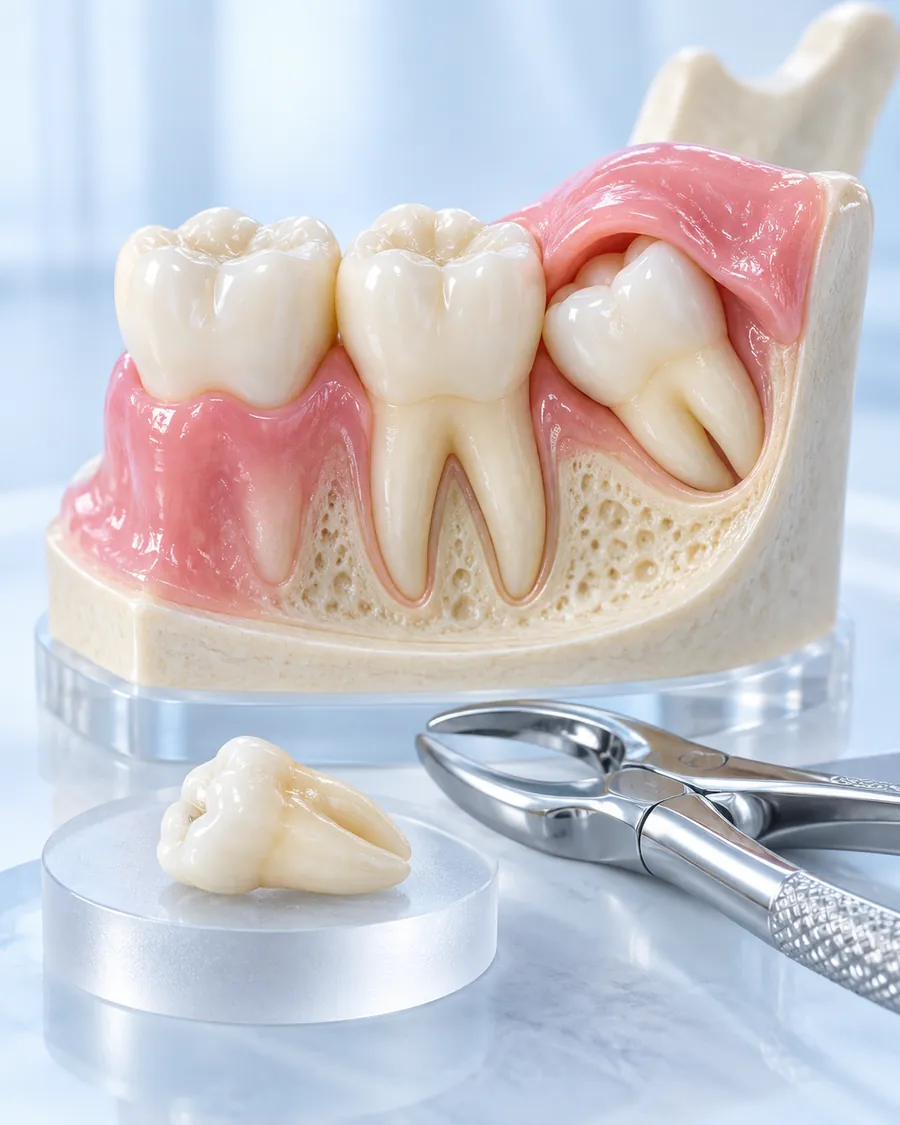
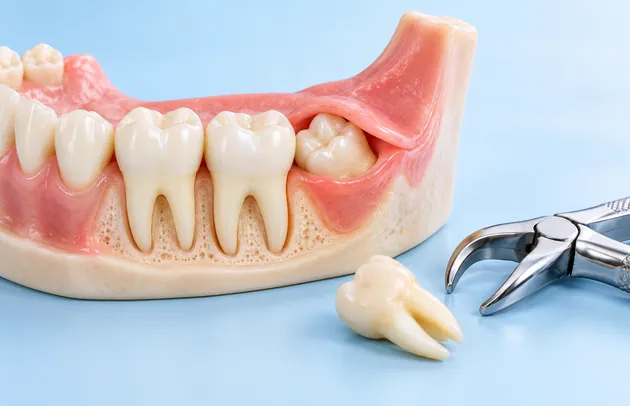
Wisdom tooth removal is the taking out of one or more third molars, which are the last teeth at the back of the mouth. When there is too little room, a wisdom tooth can be impacted, which means it cannot come through the gum properly. It may lie at an angle, press on the tooth in front or stay partly covered by gum.2
A partly covered tooth traps food and bacteria under the gum flap, which can cause repeated infection called pericoronitis. Wisdom teeth can also decay, damage the second molar in front, develop cysts, or cause pain and swelling. Removal is advised when there is disease or repeated problems. National guidance does not recommend removing healthy wisdom teeth that cause no problems.1
A straightforward wisdom tooth is taken out as described on our tooth extraction page. One that is impacted or broken below the gum may need a small surgical approach, explained on our impacted tooth removal and surgical tooth extraction pages. Wisdom teeth that are causing no problems are watched with regular check-ups and X-rays.
A wisdom tooth is removed when it causes or is likely to cause disease, not simply because it is there.
Dr. Shreya Shah decides this only after an examination and an X-ray. These are the general patterns.
If the pain is from decay in another tooth, a filling or root canal treatment may help. If a wisdom tooth is infected and painful, see dental emergency treatment for what to do the same day.
Removal is for wisdom teeth that cause disease, and an examination and X-ray show whether yours does.
Dr. Shah explains every option, including leaving the tooth and what to watch for.
A healthy wisdom tooth that causes no problems is left in place, and checked at regular visits and with X-rays. We explain the signs that mean you should call us sooner.
Regular check-upsA tooth with a mild gum infection may be cleaned and treated with rinses and cleaning under the gum flap. Decay in a wisdom tooth that can be reached may be restored.
1 or 2 visitsA tooth with repeated infection, decay that cannot be restored or damage to the tooth in front is removed. If it is impacted, a surgical approach may be needed.
Usually 1 visit| Compare | Watch | Treat the problem | Remove |
|---|---|---|---|
| Suits | Healthy, cleanable teeth | Mild or first infection, reachable decay | Repeated infection, damage, cysts |
| Surgery needed | No | No | Often a minor procedure |
| Typical visits | Regular check-ups | One or two | One, then review |
| Main risk | Problems can start later | Problems can come back | Dry socket, nerve bruising |
| Recovery | None | A few days | Several days to two weeks |
Removal is one option among several, and we explain the reasons for and against it.
A straightforward removal is usually one visit. A deeper or impacted tooth takes longer. Your plan may differ.2
Careful assessment before removal and clear aftercare afterwards matter as much as the procedure itself.
Dr. Shah asks about pain, swelling and bad taste, examines the tooth and the gum and takes an X-ray. The X-ray shows the angle, the roots and how close the tooth is to a nerve or the sinus.
You are told whether the tooth should come out, can be watched or can be treated, what removal involves, how long recovery takes and what the risks are. You decide before treatment starts.
The tooth and the gum around it are numbed with local anaesthetic. You stay awake. We wait until the area is fully numb.
If the tooth is under the gum, a small cut is made to lift a flap of gum. A little bone around the tooth may be removed to reach it.
The tooth is loosened and lifted out. A tooth with curved roots or an awkward angle may be divided into pieces so that it comes out in parts.
The socket is cleaned and any sharp edges of bone are smoothed. The area is checked for tooth fragments.
Stitches close the gum if a flap was lifted, and you bite on gauze to stop the bleeding while a clot forms.
You are given written instructions for the first days. A review visit checks healing and removes stitches if they are not dissolving.
Cost depends on your evaluation. Wisdom tooth removal is planned for each tooth, so no single figure fits everyone.
Two wisdom teeth can need very different work. After the examination and X-ray, Dr. Shreya Shah explains the stages, and the cost of each stage is discussed before you decide to go ahead.
Call 08806796696 or message us on WhatsApp. If you have trouble breathing or swallowing, or swelling is spreading to your eye or neck, go to a hospital emergency department. For other urgent problems, see dental emergency treatment.
Following the first-day instructions closely lowers the risk of dry socket.
We remove a wisdom tooth when there is a clear reason, and we say plainly when we would leave it alone.
Your first visit is an examination and a plan. If a tooth is infected and painful, removal or treatment can sometimes be done the same day, subject to availability.
Bring any earlier X-rays or reports, and a list of the medicines you take. Tell us about allergies, diabetes, heart conditions, blood thinners and tobacco use. If you have swelling, fever or severe pain, call us first so that we can arrange the earliest visit.
Call 08806796696 to book.

Removed only when neededX-ray before any decisionReferral when needed
Dr. Shah explains each step in plain language and checks that you are comfortable throughout, and you decide at your own pace. If you are anxious about dental treatment, tell us at the start and we will go at a pace that suits you. We would rather you ask every question before treatment than leave with doubts, so please bring a list.
Healthy wisdom teeth are not removed just in case. Dr. Shah explains why a tooth should or should not come out.
The position of the tooth, the roots and the nerve is checked on an X-ray before any decision is made.
You are given written instructions for the first days, and told which signs mean you should call us.
If a tooth is very close to a nerve or needs training beyond what is available, Dr. Shah says so and arranges coordinated care with a suitably trained surgeon.
These are patient reviews of the clinic and Dr. Shah, copied word for word from the clinic’s Google Business Profile. They describe the experience of visiting the clinic and are not evidence of how any treatment will turn out for you.
“Me and my family have been visiting Dr Shreya for a few years now. She makes us feel very comfortable and at ease. She is always accommodating us on urgent basis when required. Would recommend her.”
“Lovely experience. Made my dental appointment so comfortable I forgot it was my first time .”
“Dr. Shreya is really friendly and welcoming, she keeps helps you stay comfortable throughout the procedures”
Assured Dental Care is a dental clinic in Andheri West, Mumbai, next to Lallubhai Park in Parsi Colony. You can book a wisdom tooth evaluation with Dr. Shreya Shah by phone or WhatsApp. The map shows the exact location of the clinic. If your problem is urgent, please call before you travel so that we can arrange the earliest visit available. Please bring any earlier reports.
Straight answers to what patients ask before they book. If your question is not here, call or message us.
Wisdom tooth removal is planned for each tooth, so the cost is given only after your evaluation. It depends on how many teeth are removed, how they sit in the jaw, whether the tooth is impacted and needs a surgical approach, the imaging needed, the type of anaesthesia and follow-up visits. After the examination, Dr. Shreya Shah explains the plan and the cost of each stage before you decide.
No. Wisdom teeth that are healthy and cause no problems usually do not need to be removed, and national guidance advises against removing healthy ones just in case. Removal is advised when a tooth causes repeated infection, decay, damage to the tooth in front, a cyst or pain, or when it is in the way of other treatment.
An impacted tooth is one that cannot come through the gum properly, because it is blocked by the tooth in front, by bone or by the way it is angled. It may stay under the gum or come through partly. Partly erupted teeth are prone to infection of the gum around them, called pericoronitis.
The area is numbed with local anaesthetic, so you stay awake and should not feel sharp pain. You may feel pressure and vibration. Soreness, swelling and jaw stiffness for several days are common afterwards. Tell us during the procedure if you feel pain and we will pause and numb the area again.
Swelling and soreness are usually worst around the second or third day and then ease. The gum surface commonly closes over one to two weeks, and the bone beneath takes longer to heal. Most people return to normal activities within a few days, and we give you instructions for your own case.
Dry socket happens when the blood clot in the socket is lost early, usually three to five days after removal, and it causes severe, throbbing pain and a bad taste. Smoking, touching the socket and difficult extractions raise the risk. Follow the aftercare, avoid smoking, and call us if pain is getting worse instead of better.
It can, though it is not common. Lower wisdom teeth lie close to nerves that supply feeling to the lip, chin and tongue, and these can be bruised during removal, causing numbness or tingling that is usually temporary. Dr. Shah assesses the position on the X-ray first and tells you about the risk. If the tooth lies very close to a nerve, she may refer you to an oral surgeon.
Not always. Wisdom teeth do not usually need to be removed for teeth straightening, and removal is advised only if there is a clear reason such as an infection or a tooth that is in the way. We review your X-ray and explain the reasons for or against removal in your case.
If a wisdom tooth is painful, keeps getting infected or is damaging the tooth in front, an examination and X-ray show what it needs. If another clinic has advised removal, we are happy to give a second opinion. Call or message us during clinic hours and we will confirm a time with you.
Monday to Saturday, 10:00 AM to 7:30 PM.
Read this for how an ordinary extraction is done and what to expect afterwards.
Read this if the tooth is broken below the gum or lies deep in the bone.
Read this if the tooth is stuck under the gum or against another tooth.
See all dental treatments at Assured Dental Care, or read about our general dentist in Andheri West.
Written and reviewed by: Dr. Shreya Shah, Chief Dentist, Maharashtra State Dental Council registration A 30472. Last reviewed 9 October 2026. Dr. Shah is also the clinic’s treating dentist, and this page describes treatment that Assured Dental Care provides.
On the review date, Dr. Shah read the whole page and checked each clinical statement, timeline and warning sign against the sources listed below. The page is next reviewed within six months, and sooner if a source or the clinic’s process changes. To report an error, call or message the clinic using the details above.
This page is general information for patients. It is not a diagnosis or a substitute for an examination by a dentist. Treatment, timelines and outcomes vary from person to person.
