
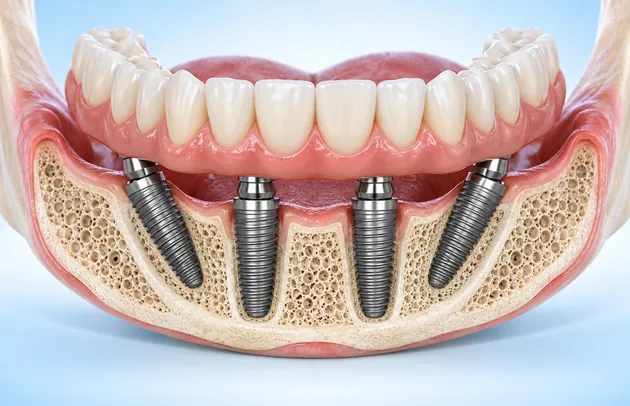
Assured Dental Care is a dental clinic in Andheri West, Mumbai, where All-on-4 is considered for people who have lost most or all of the teeth in one jaw, or whose remaining teeth cannot be saved. All-on-4 replaces a whole arch with a fixed bridge carried by four implants. The two at the front go in upright, and the two at the back are tilted so that they sit in the bone that is available, which can make a bone graft unnecessary in some mouths. It is a major treatment with risks, and it is planned from scans.
Your care is led by Dr. Shreya Shah, Chief Dentist, who first checks whether any teeth can still be saved and whether All-on-4 is the right choice compared with a denture or other implant plans. If you are looking for an implant dentist in Andheri West for a full arch, the first step is an examination and a 3D scan, followed by an honest explanation of the stages, the healing time, the care afterwards and the risks.

Medically reviewed by Dr. Shreya Shah, Chief Dentist. Last reviewed 9 October 2026. Registered with the Maharashtra State Dental Council (registration A 30472, 2015). Dr. Shah is also the treating dentist at this clinic.
All-on-4 at Assured Dental Care in Andheri West, Mumbai replaces a jaw of teeth with a fixed bridge on four implants, two upright at the front and two tilted at the back. Dr. Shreya Shah plans each case after an examination and a 3D scan. Healing takes months, and not everyone is suited.
Examination and planning start at your first visit, subject to availability.
A fixed bridge does not rest on the gums and is not taken out for cleaning, unlike a denture.
A 3D scan shows the bone, so the position of each implant is planned before surgery.
All-on-4 is a name for a method of supporting a fixed bridge of about ten to twelve teeth on four implants in one jaw. The implants are placed in the front of the jaw, and the two at the back are tilted by an angle, so that they can be longer and can sit in the denser bone at the front of the sinus or nerve, instead of needing bone to be built up first. The bridge is attached to the four implants.4
A fixed bridge is made after the implants have bonded with the bone. In many cases a temporary bridge is attached soon after surgery, so that you leave with teeth. A review of studies of immediately loaded upper jaw bridges found success rates that were comparable with later loading, with the benefit of a shorter treatment time. A temporary bridge is not always possible, and the plan depends on how firmly the implants sit.2
All-on-4 is one of several ways to replace a whole arch. Six implants are used in the All-on-6 plan, and our full mouth dental implants page compares the overall options. A removable denture is the alternative that needs no surgery, and our dental implants page covers the basics of implant treatment.
All-on-4 supports a fixed arch on four implants, two of them tilted to use the bone that is there.
Dr. Shreya Shah decides suitability only after an examination, a medical history and a 3D scan. These are the general patterns.
If only a few teeth are missing, see multiple teeth implants or a bridge instead. Teeth that cannot be saved are removed by tooth extraction, sometimes at the same visit as the implants. Gum disease needs periodontal treatment first.
All-on-4 suits some people who have lost most of their teeth, and scans and an examination show whether you are one.
The right choice depends on your bone, your health, your bite and what you want. Dr. Shah explains the options, including a denture.
Four implants, two tilted, carrying a fixed bridge. It can avoid bone grafting in some mouths and may allow a temporary bridge soon after surgery.
FixedSix implants per jaw carrying a fixed bridge. More implants can share the bite load and give a back-up if one fails, and bone must be present for them. The All-on-6 page explains more.
FixedA denture needs no surgery. An overdenture clips onto two or more implants and is removable, which makes cleaning easier. Both rest partly on the gums.
Removable| Compare | All-on-4 | All-on-6 | Denture |
|---|---|---|---|
| Implants per jaw | Four | Six | None |
| Fixed in the mouth | Yes | Yes | No |
| Surgery needed | Yes | Yes | No |
| Bone graft more likely | Less | More, if bone is thin | Not applicable |
| Typical timeline | Several months | Several months | A few weeks |
Each option has a place, and we explain all of them before you choose.
All-on-4 has a planning stage, surgery, healing and a final bridge. Your plan may have more or fewer steps.2
Careful planning from scans decides where the implants go, and the bridge is designed with them.
Dr. Shah reviews your teeth, gums, health, medicines, tobacco use and what you hope for. She examines the mouth and the bite.
A 3D scan shows the bone, the nerves and the sinus. Impressions or digital scans and photographs record your teeth and bite for planning.
The position and angle of each implant is planned from the bridge, the bone and the bite. You see the plan and the alternatives.
Gum disease and infection are treated, and teeth that cannot be saved are removed, sometimes on the day of surgery.
Under local anaesthesia, the four implants are placed, two upright in front and two tilted at the back.
If the implants sit firmly, a temporary fixed bridge may be attached. If not, a temporary denture or a delay is planned.
The implants bond with the bone over several months. You eat soft food, and review visits check the gums, the implants and the temporary bridge.
Impressions or scans are taken, and the final bridge is made in a laboratory, tried in, adjusted and fixed. You are shown how to clean it.
Cost depends on your evaluation. All-on-4 is planned for each person and each jaw, so no single figure fits everyone.
Two people who need All-on-4 can have very different plans. After the examination and scans, Dr. Shreya Shah explains the stages, and the cost of each stage is discussed before you decide to go ahead.
Call 08806796696 or message us on WhatsApp. If you have trouble breathing or swallowing, or swelling is spreading to your eye or neck, go to a hospital emergency department. For a loose bridge or other urgent problem, see dental emergency treatment.
Daily cleaning under the bridge and regular check-ups protect the implants for years.
An honest plan includes the reasons not to place implants as well as the reasons to place them.
Your first visit is an evaluation, not surgery. You can come with questions about your teeth, your health and your timeline.
Bring earlier X-rays, scans or reports, and a list of the medicines you take. Tell us about allergies, diabetes, heart conditions, blood thinners and tobacco use. If you have pain, swelling or a loose denture, call us first so that we can see you early.
Call 08806796696 to book.

Tooth-saving check firstPlanned from a 3D scanReferral when needed
Dr. Shah explains each option, its stages and its risks in plain language, and you decide at your own pace. If you are anxious about dental treatment, tell us at the start and we will go at a pace that suits you. We would rather you ask every question before treatment than leave with doubts, so please bring a list.
Dr. Shah checks whether any teeth can be saved before a whole arch is replaced, and compares All-on-4 with a denture and other plans.
A 3D scan shows the bone, the nerves and the sinus, so that the plan fits your jaw, not an average one.
All-on-4, All-on-6 and dentures are explained side by side, including their limits.
If a case needs surgery or prosthetic skills beyond what is available, Dr. Shah says so and arranges coordinated care with a suitably trained clinician.
These are patient reviews of the clinic and Dr. Shah, copied word for word from the clinic’s Google Business Profile. They describe the experience of visiting the clinic and are not evidence of how any treatment will turn out for you.
“Most relaxing dental clinic I have ever been to,and I have been to a few.what I liked the most of Dr Shreya gave me 3treament options and I was explained pros and cons of everything.”
“I am staying 45 minutes away from Dr.Shreya’s clinic but thn also I preferred to go at her only …she is very good doctor”
“Me and my family have been visiting Dr Shreya for a few years now. She makes us feel very comfortable and at ease. She is always accommodating us on urgent basis when required. Would recommend her.”
“Dr. Shreya has such a warm and positive energy that instantly puts you at ease. She made me feel comfortable throughout all my sittings. I had a root canal done, and she patiently explained every step of the procedure, which really helped reduce my anxiety. Each sitting was smooth and well-managed. I’m very happy with my experience and would highly recommend her.”
“Outstanding service from start to finish. The staff is warm and courteous, and Dr Shreya is honest, skilled, and efficient.”
Assured Dental Care is a dental clinic in Andheri West, Mumbai, next to Lallubhai Park in Parsi Colony. You can book an All-on-4 evaluation with Dr. Shreya Shah by phone or WhatsApp. The map shows the exact location of the clinic. If your problem is urgent, please call before you travel so that we can arrange the earliest visit available. Please bring any earlier reports.
Straight answers to what patients ask before they book. If your question is not here, call or message us.
All-on-4 is planned for each person and each jaw, so the cost is given only after your evaluation. It depends on whether one or both jaws are treated, the implant system, the scans and surgical guide, any tooth removal and bone work, the material and design of the temporary and final bridges, the number of visits and the follow-up. After the examination, Dr. Shreya Shah explains the plan and the cost of each stage before you decide.
All-on-4 is a way of replacing all the teeth in one jaw with a fixed bridge held by four implants. The two implants at the front are placed upright, and the two at the back are tilted so that they use the bone that is there and can be longer, which can avoid a bone graft in some patients.
In selected cases, a fixed temporary bridge is attached soon after the implants are placed. It depends on how firmly the implants sit, the quality of the bone and your bite. A temporary bridge is for use while the implants heal, and we do not promise it before the scans and the findings at surgery.
Planning takes one or more visits, surgery usually takes one visit for the jaw, and the implants then need months to bond with the bone. A final bridge is made after healing is confirmed. The total commonly takes several months, and we give an estimate after your scans.
It is a different kind of treatment. A fixed implant bridge does not come out and does not rest on the gums, but it needs surgery, costs more time and care, and has risks. A denture needs no surgery but can move and may need relining. We compare them for your mouth.
No. All-on-6 uses six implants per jaw. Reviews of studies on upper jaw bridges found no clear difference in how many implants and bridges survived with four or six implants, but there was more bone loss around the implants with four. Dr. Shah explains which suits your bone and bite.
Clean it every day with a soft brush, a water flosser and interdental brushes or floss threaders under the bridge, as we show you. Regular professional cleaning and check-ups are needed so that the gum and bone around each implant are checked. Plaque around implants can cause gum and bone inflammation.
People with untreated gum disease or infection, heavy smoking, uncontrolled diabetes, certain medicines or radiotherapy to the jaw, or strong grinding that has not been managed need caution or another plan. Some people with very little bone need a different approach. We tell you honestly if All-on-4 is not right.
If you have lost most of your teeth, or your remaining teeth cannot be saved, an evaluation shows whether All-on-4 is right for you. If you have been given an implant plan elsewhere, we are happy to give a second opinion. Call or message us during clinic hours and we will confirm a time with you.
Monday to Saturday, 10:00 AM to 7:30 PM.
Read this to see how six implants per jaw compare with four.
Read this for all the ways to replace every tooth with implants.
Read this for the alternative that needs no surgery.
See all dental treatments at Assured Dental Care, or read about our general dentist in Andheri West.
Written and reviewed by: Dr. Shreya Shah, Chief Dentist, Maharashtra State Dental Council registration A 30472. Last reviewed 9 October 2026. Dr. Shah is also the clinic’s treating dentist, and this page describes treatment that Assured Dental Care provides.
On the review date, Dr. Shah read the whole page and checked each clinical statement, timeline and warning sign against the sources listed below. The page is next reviewed within six months, and sooner if a source or the clinic’s process changes. To report an error, call or message the clinic using the details above.
This page is general information for patients. It is not a diagnosis or a substitute for an examination by a dentist. Treatment, timelines and outcomes vary from person to person.
