
Assured Dental Care is a dental clinic in Andheri West, Mumbai, where braces treatment is planned to straighten crowded, spaced or crooked teeth and to improve the way the upper and lower teeth meet. Braces are small brackets fixed to the teeth and joined by a wire. The wire is adjusted at regular visits so that the teeth move slowly to the planned position. Straighter teeth are easier to clean and can bite together more evenly.
Your care is led by Dr. Shreya Shah, Chief Dentist, who examines your teeth, gums and bite first and explains whether braces, aligners or no treatment suits you. If you are looking for a dentist in Andheri West for braces, the first step is an examination and X-rays, followed by a clear explanation of the types, the length of treatment, the cleaning and the retainers.
Medically reviewed by Dr. Shreya Shah, Chief Dentist. Last reviewed 9 October 2026. Registered with the Maharashtra State Dental Council (registration A 30472, 2015). Dr. Shah is also the treating dentist at this clinic.
Braces treatment at Assured Dental Care in Andheri West, Mumbai straightens teeth and corrects the bite with brackets and wires that are adjusted at regular visits. Dr. Shreya Shah examines your teeth, gums and bite first and plans each case. Treatment takes months to a few years, and retainers are worn afterwards.
Examination and X-rays start at your first visit, subject to availability.
Fixed braces do not depend on you remembering to wear them, so they can treat more complex bites.
Metal, ceramic, self-ligating and lingual braces are explained, so that you choose with the facts.
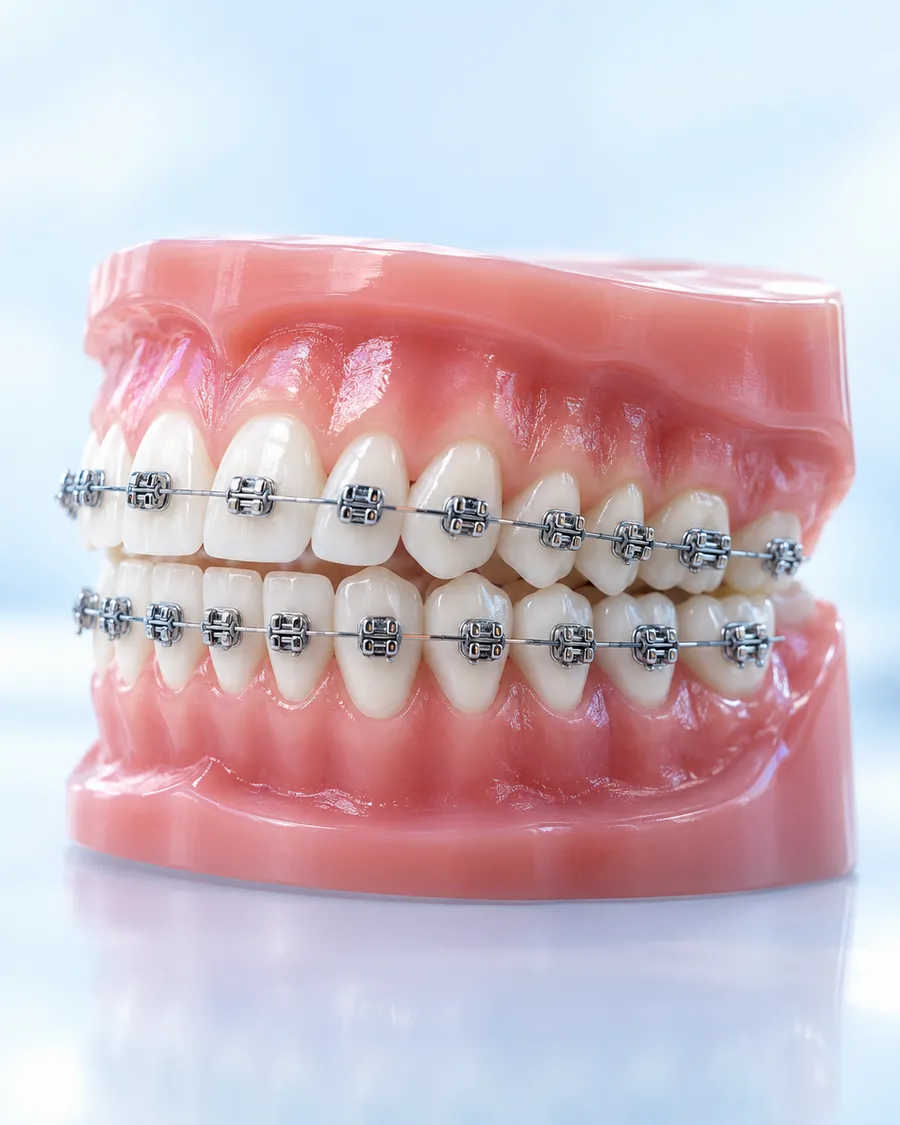
Braces are a fixed orthodontic appliance. A small bracket is bonded to the front of each tooth, and a thin wire runs through the brackets. The wire is shaped to the planned arch, and it presses gently on the teeth. The bone around each tooth slowly rebuilds as the tooth moves, which is why treatment takes months or years and cannot be rushed.1
Braces can correct crowding, gaps, teeth that stick out, and bites in which the upper and lower teeth do not meet well. Elastic bands, springs or small screws may be added for some bites. After treatment, retainers hold the teeth, because teeth tend to move back if they are not held.2
Several types of braces exist, and each is covered on its own page: metal braces, ceramic braces, self-ligating braces and lingual braces. If you prefer removable trays, see Invisalign and the clear aligners page.
Braces move teeth slowly with a wire that is adjusted at regular visits, and retainers hold the result.

Dr. Shreya Shah decides this only after an examination and X-rays. These are the general patterns.
If decay is present, a filling is done first. If gums are inflamed, gum treatment comes first. If a wisdom tooth is in the way, see wisdom tooth removal. Our orthodontist page explains when referral to an orthodontist is advised.
Braces suit many mouths, and an examination and X-rays show whether yours is ready.
The right choice depends on your teeth, your bite, how visible you want the braces to be and how you clean. Dr. Shah explains the options.
Stainless steel brackets and a wire. They are strong, widely used and can treat most bites, but they are visible.
FixedTooth-coloured or clear brackets that blend with the teeth. They work like metal braces but can stain and are more fragile.
Fixed, less visibleSelf-ligating braces use clips instead of bands, lingual braces sit behind the teeth, and aligners are removable trays. We explain which suits your case.
After discussion| Compare | Metal braces | Ceramic braces | Clear aligners |
|---|---|---|---|
| Visible | Yes | Less visible | Hardly |
| Removable | No | No | Yes |
| Complex bites | Most | Most | Some |
| Cleaning | Around brackets and wires | Around brackets and wires | Take out and clean |
| Retainers afterwards | Yes | Yes | Yes |
Each type has strengths and limits, and we explain which suits your teeth and your routine.
Braces treatment has a planning stage, an active stage and a retainer stage. Your plan may have more or fewer steps.1
Braces work step by step, and good cleaning and regular visits keep treatment on track.
Dr. Shah examines your teeth, gums, bite and jaw joints, and takes X-rays. Decay and gum disease are treated first.
Photographs, impressions or a scan are taken. Dr. Shah explains the problem, the type of braces, the likely time and what is asked of you.
If space is needed, a tooth may need to be removed or small amounts of enamel polished between teeth. This is discussed before you agree to it.
The teeth are cleaned and dried, brackets are bonded to the teeth and the first wire is fitted. Fitting does not hurt, but teeth can be sore for a few days.
You are shown how to brush around the brackets and how to clean under the wire. Good cleaning is needed for the whole of treatment.
Every few weeks the wire is changed or adjusted, and elastics or other parts are added when needed. Progress is checked at each visit.
When the teeth reach the planned position, the braces are taken off and the teeth are cleaned and polished.
Retainers are fitted to hold the teeth. You are told how long and how often to wear them, and later check-ups look at the teeth and the retainers.
Cost depends on your evaluation. Braces are planned for each person, so no single figure fits everyone.
Two people who want straighter teeth can need very different plans. After the examination and X-rays, Dr. Shreya Shah explains the stages, and the cost of each stage is discussed before you decide to go ahead.
Call 08806796696 or message us on WhatsApp. If you have trouble breathing or swallowing, or swelling is spreading to your eye or neck, go to a hospital emergency department. For a broken bracket or wire that hurts, call us, and see dental emergency treatment for other urgent problems.
Good cleaning and wearing retainers matter as much as the braces themselves.
Braces work well when teeth are healthy and cleaning is good, and we say so honestly when they are not the right choice yet.
Your first visit is an examination and a plan. Braces are not fitted at the first visit.
Bring any earlier X-rays or orthodontic records, and a list of the medicines you take. Tell us about decay, gum problems, jaw joint pain, grinding and allergies. Think about how you will manage cleaning and regular visits.
Call 08806796696 to book.

Examination before bracesTypes comparedReferral when needed
Dr. Shah explains what she finds in plain language and what each choice involves, and you decide at your own pace. If you are anxious about dental treatment, tell us at the start and we will go at a pace that suits you. We would rather you ask every question before treatment than leave with doubts, so please bring a list.
Teeth, gums, bite and X-rays are reviewed first, and problems such as decay and gum disease are treated before tooth movement.
Metal, ceramic, self-ligating, lingual braces and aligners are explained side by side, so that you choose with the facts.
You are shown how to keep teeth clean around braces and why retainers are part of the treatment.
If a case needs training beyond what is available, Dr. Shah says so and arranges coordinated care with a suitably trained orthodontist.
These are patient reviews of the clinic and Dr. Shah, copied word for word from the clinic’s Google Business Profile. They describe the experience of visiting the clinic and are not evidence of how any treatment will turn out for you.
“Most relaxing dental clinic I have ever been to,and I have been to a few.what I liked the most of Dr Shreya gave me 3treament options and I was explained pros and cons of everything.”
“Me and my family have been visiting Dr Shreya for a few years now. She makes us feel very comfortable and at ease. She is always accommodating us on urgent basis when required. Would recommend her.”
“Dr. Shreya is really friendly and welcoming, she keeps helps you stay comfortable throughout the procedures”
“Outstanding service from start to finish. The staff is warm and courteous, and Dr Shreya is honest, skilled, and efficient.”
“I have been going to Dr Shreya since the past 7years for my dental treatment and that speaks volumes.I don’t mind travelling a little extra just to get treated by her.She is the most genuine dentist around.”
Assured Dental Care is a dental clinic in Andheri West, Mumbai, next to Lallubhai Park in Parsi Colony. You can book a braces evaluation with Dr. Shreya Shah by phone or WhatsApp. The map shows the exact location of the clinic. If your problem is urgent, please call before you travel so that we can arrange the earliest visit available. Please bring any earlier reports.
Straight answers to what patients ask before they book. If your question is not here, call or message us.
Braces are planned for each person, so the cost is given only after your evaluation. It depends on the type of braces, how much your teeth need to move, the expected length of treatment, whether teeth must be removed or space made, the number of adjustment visits, the X-rays and records and the retainers afterwards. After the examination, Dr. Shreya Shah explains the plan and the cost of each stage before you decide.
Braces are small brackets fixed to the teeth and joined by a wire. The wire is shaped so that it presses on the teeth gently, and the teeth move slowly in the bone as it is adjusted at regular visits. Elastic bands or springs may be added to move teeth or correct the bite.
Most people wear braces for many months to a few years, depending on how far the teeth have to move and how closely the advice is followed. Dr. Shah gives an estimate after the examination, and the estimate can change as treatment goes on.
Braces do not hurt while they are being fitted, but teeth and gums can be sore for a few days after fitting and after adjustments. Brackets can rub the cheeks or lips at first. We give you wax and advice for this, and it settles as you get used to them.
Hard, sticky and chewy food can break brackets or bend wires, so avoid hard sweets, nuts, popcorn, toffee and biting into hard food. Cut up apples and similar food, and cut down on sugary food and drink, which cause decay around the brackets.
Brush twice a day with fluoride toothpaste, taking time around each bracket, and clean between your teeth and under the wire with interdental brushes or a floss threader. Plaque collects around braces, so poor cleaning can cause decay and swollen gums, and treatment may be stopped if cleaning is not good.
Yes. Teeth tend to move back after braces are removed, so retainers are worn to hold them. How often and for how long is explained at the end of treatment, and many people wear them at night for years. Without them, teeth can move back.
Neither is better for everyone. Braces work all the time and can treat more complex bites, but they are visible and need more careful cleaning. Aligners are removable and almost invisible but need 20 to 22 hours of wear a day. Dr. Shah explains which suits your teeth.
If your teeth are crowded, spaced or do not meet well, an examination and X-rays show whether braces suit you and what the plan would involve. If another clinic has given you a braces plan, we are happy to give a second opinion. Call or message us during clinic hours and we will confirm a time with you.
Monday to Saturday, 10:00 AM to 7:30 PM.
Read this if you prefer clear removable aligners to fixed braces.
Read this for the most widely used type of fixed braces.
Read this if you want fixed braces that are less visible.
See all dental treatments at Assured Dental Care, or read about our general dentist in Andheri West.
Written and reviewed by: Dr. Shreya Shah, Chief Dentist, Maharashtra State Dental Council registration A 30472. Last reviewed 9 October 2026. Dr. Shah is also the clinic’s treating dentist, and this page describes treatment that Assured Dental Care provides.
On the review date, Dr. Shah read the whole page and checked each clinical statement, timeline and warning sign against the sources listed below. The page is next reviewed within six months, and sooner if a source or the clinic’s process changes. To report an error, call or message the clinic using the details above.
This page is general information for patients. It is not a diagnosis or a substitute for an examination by a dentist. Treatment, timelines and outcomes vary from person to person.
