
Assured Dental Care is a dental clinic in Andheri West, Mumbai, where tongue-tie is assessed to find out whether it is causing a problem and whether treatment would help. Tongue-tie is a short or tight band of tissue under the tongue, called the lingual frenulum, that holds the tongue down and limits how far it can move. Many tongue-ties cause no trouble and need no treatment. When one does cause trouble, with feeding, eating, speaking or cleaning the teeth, a small procedure to release it can be considered.
Your care is led by Dr. Shreya Shah, Chief Dentist, who looks at the tongue and the frenulum, asks about feeding, eating and speech and explains what she finds in plain language. If you are looking for a dentist in Andheri West to assess a tongue-tie, the first step is an examination, followed by a clear explanation of whether to watch, treat or refer, and referral for babies with feeding problems when that is the right step.
Medically reviewed by Dr. Shreya Shah, Chief Dentist. Last reviewed 9 October 2026. Registered with the Maharashtra State Dental Council (registration A 30472, 2015). Dr. Shah is also the treating dentist at this clinic.
Tongue-tie assessment at Assured Dental Care in Andheri West, Mumbai checks whether a short band under the tongue is causing trouble with feeding, eating, speech or cleaning. Dr. Shreya Shah examines the tongue and explains whether to watch, treat or refer. Many tongue-ties need no treatment, and babies with feeding problems are referred for assessment.
An assessment can often be arranged quickly, subject to availability.
The tongue, the band and the problem it causes are looked at before treatment is suggested.
Many tongue-ties need no treatment, and we say so, and we refer when another clinician is better placed.
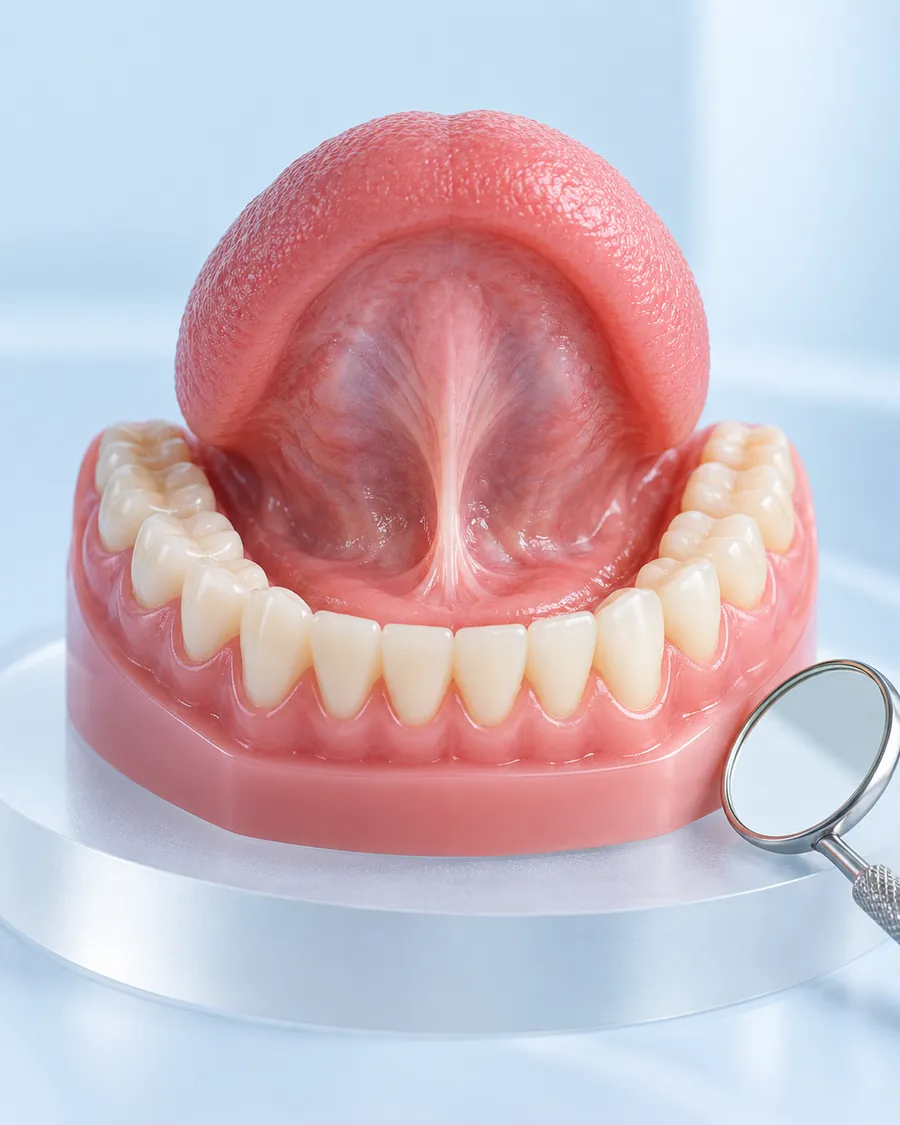
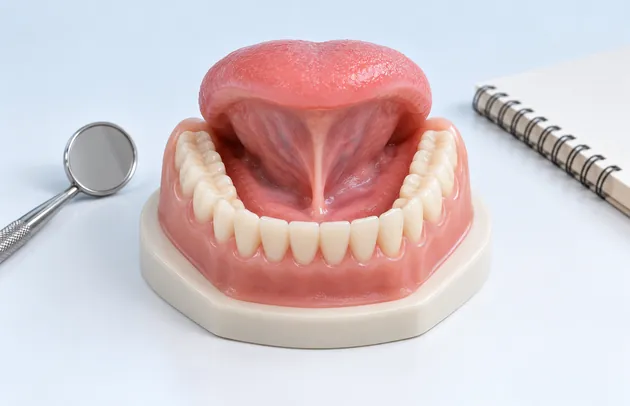
The lingual frenulum is the thin fold of tissue that joins the underside of the tongue to the floor of the mouth. In tongue-tie, or ankyloglossia, it is short, thick or attached close to the tip, so that the tongue cannot lift, stick out or move from side to side as freely as usual. It is present from birth, and it ranges from very mild to quite tight.1
Tongue-tie does not always cause problems. In some babies it makes it hard to latch on to the breast, and feeding problems have many possible causes that need assessing. In older children and adults, it can limit certain tongue movements, and may make it harder to clean food off the teeth or contribute to a gap between the lower front teeth. There is limited evidence on whether releasing it improves speech.1
When treatment is chosen, a small procedure called a frenectomy, or frenotomy, releases the frenulum. NICE has reviewed the release of tongue-tie in babies for breastfeeding problems. In children and adults it is a minor procedure done under local anaesthesia. Children's care in general is covered on our children's dentistry page, and other minor oral procedures on tooth extraction and gum contouring.
Tongue-tie matters only when it causes a problem, and an assessment shows whether yours does.
Dr. Shreya Shah decides what is needed only after an examination. These are the general patterns.
For a baby with feeding problems, assessment by a feeding adviser and a doctor comes first. For children in general, see the children's dentistry page. If a child has pain or bleeding in the mouth after an injury, see dental emergency treatment.
Many tongue-ties need nothing, and an assessment finds the few that do.
Dr. Shah explains every option, including doing nothing, and which one suits the patient's age and problem.
A tongue-tie that causes no problem is left, and checked again if symptoms appear. We explain what to look for, such as feeding trouble or speech difficulty.
Regular reviewA short procedure releases the tight band, done under local anaesthesia in older children and adults. Exercises may be advised afterwards.
Usually 1 visitBabies with feeding problems, very young children, and complex cases are referred to a feeding adviser, a paediatrician or a clinician trained in infant tongue-tie release.
Planned per case| Compare | Watch | Release at the clinic | Refer |
|---|---|---|---|
| Suits | No problem from the tie | Older child or adult with a clear problem | Babies, feeding problems, complex cases |
| Procedure needed | No | Small, under local anaesthesia | Depends on the assessment |
| Typical visits | Reviews | One, and a follow-up | Depends |
| Aftercare | None | Gentle exercises and checks | As advised |
| Main risk | Problems may appear later | Bleeding, soreness, reattachment | Depends |
The right route depends on the patient's age and on whether the tie is causing a problem.
Most patients have an assessment first, and treatment only when it is needed. Your plan may differ.2
Assessment comes first, and a procedure is done only when it is likely to help.
Dr. Shah asks about feeding, eating, speech, cleaning and any pain, and what has been tried or advised already.
She looks at the tongue and the frenulum, checks how far the tongue lifts, sticks out and moves, and looks at the teeth and gums.
You are told how tight the frenulum is, whether it explains the problem and whether to watch, treat or refer.
If a baby has feeding problems, or the case is complex, referral to a feeding adviser, paediatrician or suitably trained clinician is explained and arranged.
If a release is planned for an older child or adult, the area is numbed with local anaesthetic, and a child's parent gives consent.
The tight band is released with a small cut or instrument. This is quick, and only a little tissue is involved.
A stitch may be placed, and gentle pressure with gauze stops bleeding. You are shown what to expect.
You are given written advice, which may include gentle tongue exercises. A review visit checks healing and tongue movement.
Cost depends on your evaluation. Tongue-tie care is planned for each person, so no single figure fits everyone.
Two patients with tongue-tie can need very different care. After the examination, Dr. Shreya Shah explains the plan, and the cost of each stage is discussed before you decide to go ahead.
Call 08806796696 or message us on WhatsApp. If you or your child have trouble breathing or swallowing, or heavy bleeding that does not stop, go to a hospital emergency department. For other urgent problems, see dental emergency treatment.
Gentle exercises and a review visit help the area to heal well.
Treatment is for tongue-ties that cause a real problem, and we refer when another clinician is better placed.
Your first visit is an assessment and a plan. A procedure is done only after we have talked it through with you.
For a baby, bring any notes from a midwife, health visitor, lactation consultant or doctor. For a child, tell us about speech or feeding concerns. Tell us about medicines, bleeding problems and allergies. If a baby is struggling to feed, please see a feeding adviser or doctor first.
Call 08806796696 to book.

Assessment before treatmentHonest about needReferral when needed
Dr. Shah explains what she finds in plain language, and you decide at your own pace. If you or your child are nervous, tell us at the start and we will go at a pace that suits you. We would rather you ask every question before any procedure than leave with doubts, so please bring a list, and tell us what worries you or your child most.
The tongue, the band and the problem it causes are looked at before any procedure is suggested.
Many tongue-ties need no treatment, and Dr. Shah says so when that is the case.
You are given written instructions and exercises, and told which signs mean you should call.
Babies with feeding problems and complex cases are referred to a suitably trained clinician, and Dr. Shah arranges the coordinated care.
These are patient reviews of the clinic and Dr. Shah, copied word for word from the clinic’s Google Business Profile. They describe the experience of visiting the clinic and are not evidence of how any treatment will turn out for you.
“Me and my family have been visiting Dr Shreya for a few years now. She makes us feel very comfortable and at ease. She is always accommodating us on urgent basis when required. Would recommend her.”
“Lovely experience. Made my dental appointment so comfortable I forgot it was my first time .”
“Dr. Shreya is really friendly and welcoming, she keeps helps you stay comfortable throughout the procedures”
Assured Dental Care is a dental clinic in Andheri West, Mumbai, next to Lallubhai Park in Parsi Colony. You can book a tongue-tie assessment with Dr. Shreya Shah by phone or WhatsApp. The map shows the exact location of the clinic. If your problem is urgent, please call before you travel so that we can arrange the earliest visit available. Please bring any earlier reports.
Straight answers to what patients ask before they book. If your question is not here, call or message us.
Tongue-tie care is planned for each person, so the cost is given only after your evaluation. It depends on the age of the patient, how tight the band is, whether treatment is needed or only monitoring, where it is done, the type of anaesthesia and any follow-up exercises or referral. After the examination, Dr. Shreya Shah explains the plan and the cost of each stage before you decide.
Tongue-tie, or ankyloglossia, is when the thin band of tissue under the tongue, called the lingual frenulum, is short or tight, so that the tongue cannot move as freely as usual. It is present from birth. In some people it is very mild, and in others it limits how far the tongue can lift or stick out.
No. Many tongue-ties cause no problem and need no treatment. Treatment is considered when the tie causes feeding difficulty in a baby, or in older children and adults when it clearly limits eating, speaking or cleaning the teeth, or contributes to a gap between the lower front teeth. Dr. Shah assesses the individual.
In some babies, a tight frenulum makes it hard to latch and feed, and the mother can have pain. Because feeding problems have many causes, a baby is first assessed by someone trained in infant feeding, such as a midwife or lactation consultant, and a doctor. We look at the tongue, and refer babies for assessment when appropriate.
Not always. Many children with tongue-tie speak clearly, and speech problems have many other causes. Where a tight tongue limits certain sounds, releasing it may help, but speech therapy may also be needed. We explain what to expect honestly and may suggest an assessment by a speech therapist.
The frenulum is released, either by a small cut or with a small instrument, after the area is numbed. In young children and babies this is often a quick procedure done by a suitably trained clinician. In older children and adults it is done under local anaesthesia, sometimes with a stitch. Exercises may be advised afterwards.
There can be a little bleeding, soreness and swelling, and rarely infection or reattachment of the tissue. Pressure on the area with clean gauze usually stops bleeding. Dr. Shah explains the risks, and we give aftercare advice and a number to call.
Dr. Shah examines the tongue and asks about feeding. If a baby has feeding problems, she may suggest that you see a feeding adviser, a paediatrician or a clinician trained in infant tongue-tie release. She explains why and arranges coordinated care.
If you or your child have a tight band under the tongue and trouble with eating, speech or cleaning, an assessment shows whether treatment would help. If a baby is struggling to feed, please see a feeding adviser or your doctor too. Call or message us during clinic hours and we will confirm a time with you.
Monday to Saturday, 10:00 AM to 7:30 PM.
Read this for the wider picture of caring for children's teeth and mouths.
Read this for another minor procedure on the soft tissues of the mouth.
Read this for how minor oral procedures are done under local anaesthesia.
See all dental treatments at Assured Dental Care, or read about our general dentist in Andheri West.
Written and reviewed by: Dr. Shreya Shah, Chief Dentist, Maharashtra State Dental Council registration A 30472. Last reviewed 9 October 2026. Dr. Shah is also the clinic’s treating dentist, and this page describes treatment that Assured Dental Care provides.
On the review date, Dr. Shah read the whole page and checked each clinical statement, timeline and warning sign against the sources listed below. The page is next reviewed within six months, and sooner if a source or the clinic’s process changes. To report an error, call or message the clinic using the details above.
This page is general information for patients. It is not a diagnosis or a substitute for an examination by a dentist. Treatment, timelines and outcomes vary from person to person.
